
Pubblicato in: Tools & Materials

Rewind : Paralume & Telaio

Un’entità del design con cui la forma entra significativamente in relazione con lo spazio: il paralume.

Telaio Cilindro - Drum Frame
Telaio Cilindro – Drum Frame

ll telaio è l’ossatura del paralume, l’adeguamento della forma alla sua moderna funzione, ovvero un insieme di elementi che costituiscono lo scheletro rigido portante di una struttura a cui sono collegati parti di minore resistenza.  Dotato di due o più ordini di fili metallici diritti che uniscono i bordi inferiore e superiore, ha al centro un supporto per agganciare la lampadina.
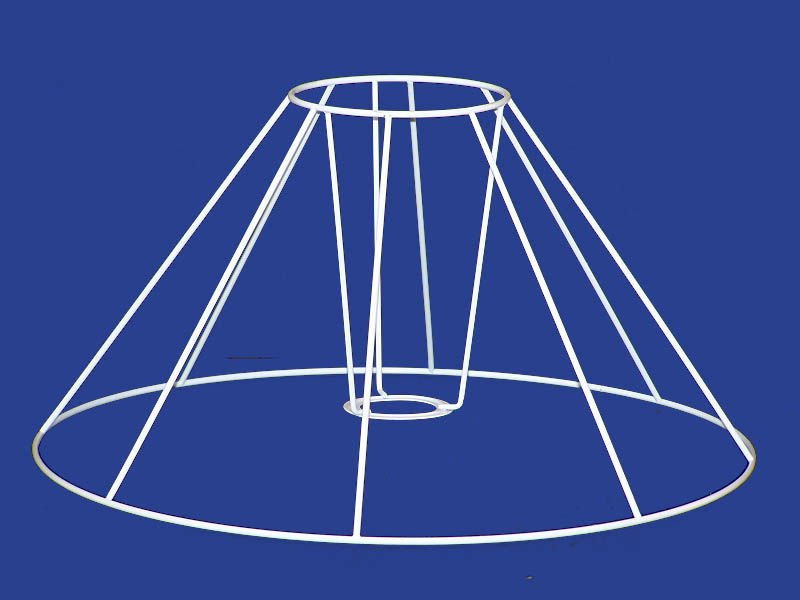
Telaio Cinese - Round Chineese Coolie Frame
Telaio Cinese – Round Chineese Coolie Frame

Questo supporto centrale può avere varie misure: un attacco portalampadina grande, o piccolo, eventualmente con riduttore (sistema europeo); altresì con innesto e finale, a molla o a clip (attacco sistema americano).  Il telaio è realizzato in filo metallico zincato verniciato, o plastificato, di colore bianco, per evitare l’ossidazione e la formazione di ruggine.
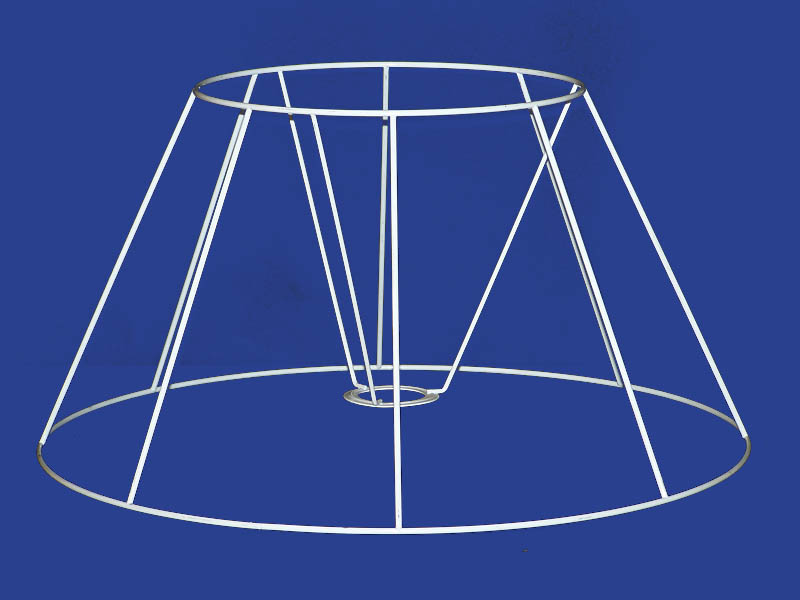
Telaio Impero - Round Empire Frame
Telaio Impero – Round Empire Frame

 Il suo punto di forza è il rapporto con la tradizione; vi sono due principali categorie di telai per paralumi: il telaio a figura geometrica intera e il semi-telaio a scudo o a ventana.  Le forme sono numerose, da quelle classiche rotonde e quadrate fino a quelle più artistiche o bizzarre.

Telaio Ovale - Oval Frame
Telaio Ovale – Oval Frame

Il telaio può essere frutto del sapiente lavoro artigianale che consente di apprezzarne anche l’imperfezione, l’irregolarità e l’asimmetria, oppure della moderna produzione industriale standardizzata; tuttavia, nei confronti della lavorazione meccanica, quella manuale rappresenta l’espressione della creatività e dell’invenzione della forma.

Telaio Pagoda Quadra - Square Bell Frame
Telaio Pagoda Quadra – Square Bell Frame

Scegliere la forma del paralume più adatta fa la differenza: moderna o classica, shabby chic o country-style, decorata o lineare, in ogni caso bisogna iniziare dalla base, o piantana, e determinare quale sia realmente consona alle specifiche esigenze di illuminazione e home decor.
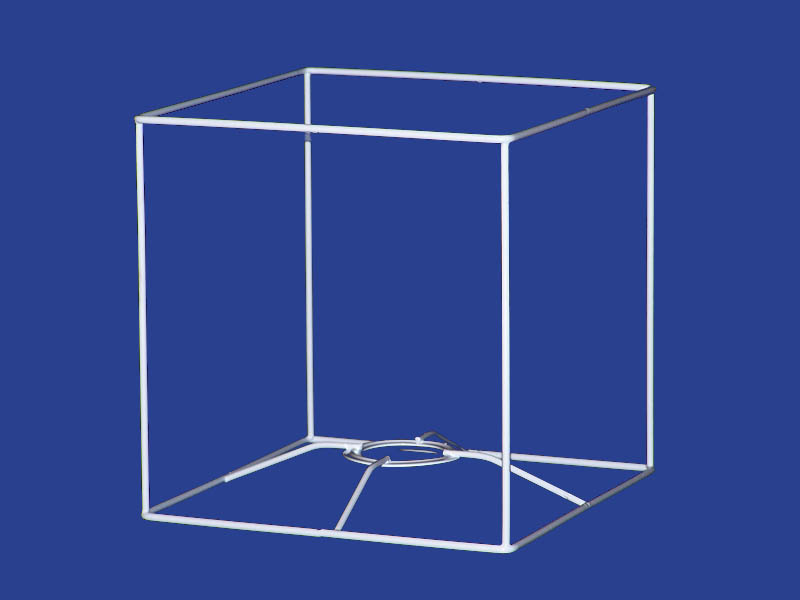
Telaio Quadrato - Square Frame
Telaio Quadrato – Square Frame

Una buona regola: base quadrata con paralume quadrato, piramide, pagoda quadra o rettangolare; base rotonda con paralume tondo, sferico, cilindrico, cinese, ovale o impero.

Telaio Piramide - Square Coolie Frame
Telaio Piramide – Square Coolie Frame

Il telaio cilindrico svasato, o tronco di cono, e quello smerlato si adattano perfettamente alla base a candelabro.  La base riccamente decorata, o molto curva, sceglie il telaio pagoda leggermente stondato dal bordo superiore a quello inferiore.  Se la base è lineare, il telaio sarà diritto e verticale.

Telaio Tronco di Cono - Round Bell Frame
Telaio Tronco di Cono – Round Bell Frame

Lo stile vittoriano inglese si sposa magnificamente con il telaio smerlato in tutte le sue varianti.  Il moderno design di tendenza abbina altissime piantane a grandi telai ovali.  Il telaio a ventola è ideale per gli abat-jours, mentre quello impero è il vero passepartout!

Telaio Ventola - Round Shield Frame
Telaio Ventola – Round Shield Frame
Telaio Pagoda Smerlata - Scallop Square Bell Frame
Telaio Pagoda Smerlata – Scallop Square Bell Frame
Pubblicato in: Tools & Materials

Lampshade & Frame

(pls enter on the italian translation)

An entity of interior design that develops and turns a space into an effective conceptual project and enters significantly in relation with its form: the lampshade.

Telaio Cilindro - Drum Frame
Telaio Cilindro – Drum Frame

The frame is the backbone of the lampshade, the efficient adaptation to its modern function.  It is composed by a set of elements making up the skeleton of a rigid supporting structure with which some parts of less resistance are connected.

Telaio Pagoda Quadra - Square Bell Frame
Telaio Pagoda Quadra – Square Bell Frame

A lampshade has a metal structure with two or more orders of straight wire supports holding up the upper and the lower edges; the frame has a central socket to attach the light bulb and is made of a metallic wire, galvanized or covered with plastic, usually painted white to prevent oxidation and rust.

Telaio Cinese - Round Chinese Coolie Frame
Telaio Cinese – Round Chinese Coolie Frame

The lamp saddle and socket can have different sizes: the small E14 or the large E27 wire fitting, eventually with a reducer or an adapter ( i.e. a white plastic ring, or a converter plug, that goes between the socket and the bulb), permanently attached to the shade which is directly installed to the lamp socket (EC European or BC British fitting system).

Continua a leggere “Lampshade & Frame”

Pubblicato in: Tutorials

Lampshade & Fabric

The template.  It is important to draw the template, in order to cut the fabric in the right measures.  First of all I take a large piece of thin paper, or pattern paper, (or more paper sheets joined together with adhesive tape) and a soft pencil.  Then I lay the shade (already provided for its polystyrene panels) on it and, from the vertical rear seam, I begin to roll the shade and to trace around the rims on all sides to the starting point.  With a ruler I extend the sides of each line out 2-3 cm. and trace a further edge in all directions the lines were heading.  Finally, I cut the template out of the piece of paper with scissors or a craft cutter.  Now the template is ready.

Preparing the fabric.  To select the right fabric to cover my shade, in addition to considering colour and design, I have to consider its transparency as well as the amount of heat my lamp expels because I do not want my chosen material to melt.  That’s why I read the fabric label carefully to determine its heat sensitivity.  Afterwards I wash and iron the fabric perfectly.  I lay the template on the wrong fabric side and I trace it with a soft pencil.

Checking up fabric design.  The above mentioned template process, although laborious, helps me to understand everytime if the fabric design is suitable for my lampshade.  The correct fabric position is important: the design must be in evidence, both on the front and on the rear shape side; it should not be cut out badly on the edges and pretty harmonious!  On the contrary, I can always remove the fabric and take it on again, or even replace it, in order to get a first-rate colour-rich canvas.

Cutting the fabric.  I place the template on the wrong side of my fabric and trace all cutting lines with a soft pencil.  I cut the fabric out carefully.  The new cover is now ready to be glued to the shade.

Continua a leggere “Lampshade & Fabric”

Pubblicato in: Shadow & Art Box Frames

A Birthday Gift & Japan !

a birthday gift & japan 5a birthday gift & japan 2

a birthday gift & japan 3 a birthday gift & japan 6

 Beautiful japanese 100% cotton fabric and Kokeshi soft-paper dolls and small tree.  What an idea for a unique birthday gift: to decorate a 30×40 cm. canvas with the decoupage technique.  First of all I need a soft pencil to design the template on the canvas front side, the scissors to cut out my fabric symmetrically and vinyl glue (or special fabric-glue).  Also a flat brush to spread an adequate glue measure on to paste the ten fabric pieces, my fingers to hold and press the fabric down while it dries.  Then I use a satin water-based varnish gel to create a protective finishing.  I apply a thin uniform coat with a specific smooth flat brush and let dry for at least six hours.  I repeat twice, or three times.  Finally, I paste the japanese Kokeshi soft-paper dolls and small tree to the copper lamina and cut them out carefully.  I glue them with hot-melt adhesive by a hot-glue gun directly to my fabric.  To embellish I choose a white wooden frame.