
Lock & Key.

Follow my pawprints, hold on my smile, laugh at my jokes, walk by my side, find me where my soul flourishes, come closer to my heart, look into my dream every single day!


Lock & Key.
How to measure and cut fabric safely. The cutting mat is the perfect tool for some general requirements: to protect work surfaces, to make measuring easy, to give a useful measuring guide, i.e. an easy-to-read grid on one or both sides for precise drawing and cutting, to offer a significant combination for crafting precision and mistake-free measuring.

The protective cutting mat is made with 3 or 5 composite layers of resilient vinyl that heals completely; again, of 100% recyclable polypropylene for an environmentally responsible disposal. Long-lasting, non-slip, non-glare, water-repellent to liquid spills, self-healing surfaces that are designed for rotary cutters, art knives, standard-duty cutters and utility blades: the mat can be cut and slashed repeatedly without displaying marks, cutting lines or abrasions. In fact, its special surface prevents blades from becoming dull.

How to measure fabric. A ruler is a ribbon of cloth or a strip of wood, plastic, metal or other material, which has straight edges usually graduated in millimetres or inches. It is a common measuring tool used in geometry, printing industry, technical drawing and in quilting/patchwork projects and has three main purposes: to measure distances, straight lines and solid bodies; to mark and score a line on a surface with a rotary cutter; to help drawing accurate graphs, flexible geometric shapes and flat curves.

There are different types of rulers: standard slotted rulers, standard and flexible tape measures, rigid wooden or metallic folding carpenter’s rulers, self-retracting roll-up tape measures, line gauges, sewing gauges, straight-edges, etc.

Since the Paleolithic Era primitive human beings adopted measuring devices, according to incoming needs and rituals, mainly consisting of natural fibers, marked strips of leather or ivory sticks. Gilded bronze rulers dated 206 B.C. were discovered in China in the Hanzhong Prefecture (in the southwest of Shaanxi Province). In the 16th century wooden carpenter’s rulers and other measuring tools were found on board of the merchant carrack Mary Rose. Anton J. Ullrich invented the folding ruler in 1851. In 1922 Hiram A. Farrand started mass production of his rapid ruler. The spring tape measure existed since Alvin J. Fellows’ patent in 1868, but did not come into wide usage until the early 1900s, when carpenters began slowly adopting Farrand’s design as the one more commonly used. And which is the today design of all modern tape measures.


How to measure a lampshade. There are six basic lampshade shapes: coolie, drum, empire, bell, oval and square. It is important to find out the right lampshade size. Dimensions typically given are: top x bottom x height on the vertical slant. The taller the lamp, the larger the shade. Height is the most significant factor in choosing the lampshade; in fact, it must cover the hardware but at the same time be proportionate to the base size. As well, width is the next important measurement: it is necessary to get 3-4 inches space from the bulb to the shade, especially for higher wattage bulbs. Be sure the top opening is wide enough to vent the heat.
a) vertical height; b) bottom width; c) vertical slant; d) top diameter.
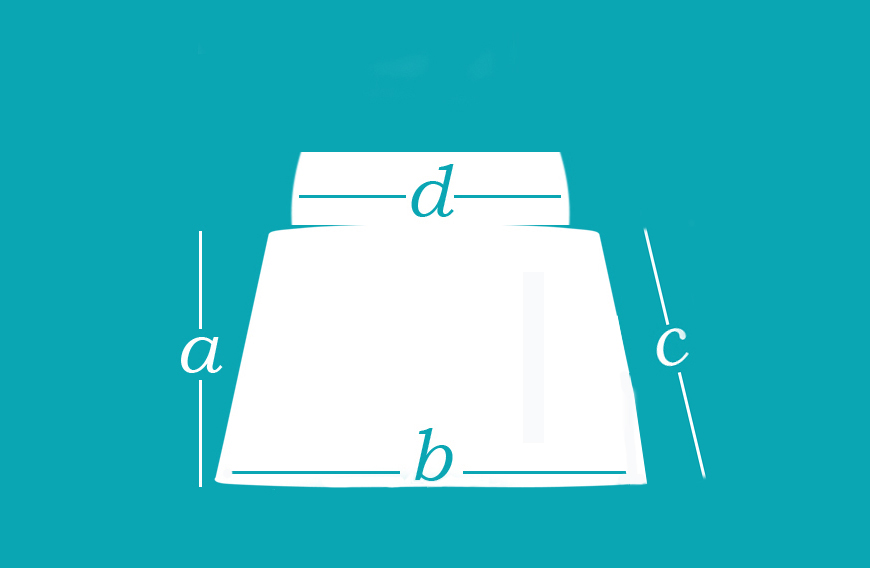
The bottom size/width of the shade (b) should be similar or equal to its lamp base height (c).

The shade vertical height (a) should be about two-thirds the lamp base height/size (c).

The lower lampshade size/width (b) should be approximately one-third up to 50% wider than the widest part of its base (d).



Ich weiß… Ich bin spät dran: zu viele Dinge zu tun und keine gute Möglichkeit, sie zu tun. Ich möchte gerne neue technischen Beiträge schreiben, wirklich!… aber es gibt sehr viel dafür vorzubereiten: oh je, der Weg zur Hölle ist mit guten Vorsätzen gepflastert!
 TopoloD3xter
Devi effettuare l'accesso per postare un commento.